The great DBate; Steve Hodder in conversation – 10.30 today!

It’s the hottest question in pensions, one that’s exercising the Bank of England , the PRA , TPR and should be exercising you today.

I’ll be putting the tough questions to LCP’s Steve Hodder, the man who spoke  for LCP in the the dark days of the LDI crisis and is speaking for them at next week’s Pension PlayPen coffee morning.

If you have any interest in pensions, DB or otherwise and you are alert to the nature of this £1.5 trillion opportunity then you should register. If you don’t know what I am going on about, read this morning’s blog “Not so fast, BOE calls for moderation in all things

If you’ve got time , read the transcript to the BOE’s Charlotte Gerkin’s call for moderation

And if you’d given up hope that we’d ever here encouragement for DB schemes to do more than lockdown, have a read of TPR’s Annual Funding Statement  –  and its announcement that contains the word “ambitious” in relation to long term funding targets.

As Steve Hodder has been saying on Linked in , while there is a rush to the factory gates where some advisers are handing out chicken dinners, schemes might want to take a step back and consider the merit of paying pensions!


REGISTER HERE

Posted in pensions | Tagged , , | Leave a comment

Could we stomach Aussie rules in UK pensions?


Australian regulation is as hard as its sport. It’s coming to a regulator near you. Read this blog and ask yourself whether we want regulators’ that influence or whether Aussie rules , overstep the mark.

This is the Australian regulator’s dashboard of products available to Australian Citizens saving for their retirement.

These are my edited highlights of Apra’s promotion of its approach (you can read the full document here)

APRA is focused on driving a culture of continuous improvement, accountability, and transparency in the delivery of quality outcomes by RSE licensees to superannuation members.

Legislative reforms, including the annual performance test, have sharpened the focus on the financial nature of an RSE licensee’s duty to act in the best financial interests of beneficiaries.APRA uses the heatmap as a tool to hold RSE licensees to account for underperformance and help them identify areas for ongoing improvement. APRA expects RSE licensees to take both the annual performance test and heatmaps into account when assessing performance, to identify where outcomes for members need to be improved and how such improvements will be made.

What this boils down to , is that Apra is calling out self-select funds that aren’t delivering to member outcomes and doing so in a very public way.

You can see that the funds highlighted as failing are available under a variety of licences (think master trusts, workplace GPP and SIPP.

We don’t need to concern ourselves with the precise comparisons as we are not taking decisions on Australian funds (we being my UK readership). But we should be very interested in the inferences being drawn by Apra from its analysis.

From this analysis, Apra is telling its readership (from fund manager to consumer)

Choice investment options are more likely to have underperformed than MySuper products.

Closed Choice investment options have had particularly weak performance with 39% significantly below heatmap benchmarks, accounting for almost a quarter of the member benefits invested in these options.

This kind of analysis has become deeply unpopular in the UK over the past 40 years. The famous dictum “past performance is no guide to the future” has been rolled out whenever comparisons like these have been made. The dictum comes from and is endorsed by various UK regulators – and consistently.


So why should this concern us?

However you measure it, performance matters, it is what turns meagre contributions into massive pots, if you get good performance your need for top-up contributions diminishes, your prospects of a proper income in retirement increases. Performance is the measure of our retirement dreams and Apra is pointing out that your chances of getting good performance increases markedly when in certain arrangements over others.

And this approach concerns us because it is the direction of travel in UK regulation and if you are operating a UK fund or a UK funds platform and offering your wares as a workplace pension or an open SIPP or as a legacy pension, you should be thinking about your duty to your consumer and working out how you can best offer value for money.

Like it or not, your actions over the next few years are going to be compared with the outcomes you have achieved over the past few years. You may not like this, but this is the cold sobre reality.


Measuring by outcomes

I remember sitting in a roomful of IFAs , maybe 6 or 7 years ago and asking how they measured the outcomes of what they were doing against what they’d promised and their clients expected. One gnarled veteran looked at me and said “we gave up measuring outcomes long ago, if we measured ourselves in this way, most people in this room would be out of business”. There was some nervous laughter from those who knew I might blog about that comment, I did – we were in Chatham House – but it didn’t matter who said it, what matters is that the comment went unchallenged.

Apra are not just leading, they are laying a trail for others to follow. This report goes much further than Value Assessments, IGC and Trustee Chair Statements, it draws conclusions for people from the data it has aggregated and makes some pretty clear statements.

Do we want regulation like that? I suspect that most people in financial services don’t and most of their customers – were they to pay this mind – do.

We look at Australia and admire people’s interest in their retirement affairs and their engagement with the things they need to do to improve their prospects.

But when it comes to adopting the measures that have created this interest and engagement, these clear reports and recommendations, we are reluctant to follow the trail.

My friend , Jim Hennington , asks the question on linked in.

“Is a regulator right to be a Finfluencer?”

What do you think?

Posted in pensions | Tagged , , , | Leave a comment

Buying a pension with my workplace pension pot – why not?

In this article, I look back to the bad old days when people who didn’t choose got “clubbed” by insurers . I look forward to a system that ensures everyone gets a reasonable pension for their savings , whether they choose it or not.


What a rip-off “money purchase” could be!

It’s worth remembering what happened in the bad old days when a money purchase scheme meant you “purchased” an annuity. Typically you were put into an insured occupational pension run by an old fashioned insurer (a CIMP or COMP) and when you got to your scheme retirement age you were offered an annuity from the insurer of your scheme. In the small print you might be advised to use an open market annuity option which meant you could shop around for the best rate. Few people did and the practice of offering dud annuities to the mug punter became known in insurance circles as “seal clubbing”.

For reasons, the FSA could never work out, people chose the devil they knew , even though it might be wearing a tee advertising “I club baby seals”

Because these people did not have advisers – were vulnerable and most are now surviving on very poor annuities.

The seal clubbers have retired on handsome DB pensions and we now have a consumer duty that will ensure that such iniquities will never happen again (ahem).


But  was it much worse  than the current state of affairs?

In the old days, the baby seals poked their head out from the ice and got clubbed, but though they got a headache, they did get some sort of pension. The pension freedoms meant that they got a pot which was all very well as long as the pot doesn’t get lost or cashed out creating more headaches from the taxman.

We all know that the current system doesn’t work very well unless you are smart enough to know your investment pathways and can consolidate your pots to keep some semblance of organisation over cashflows. Without a dashboard and with woefully inadequate choice architecture, those with too little to warrant the attention of an adviser are drawing down i the dark


Getting the balance right.

We need a standard way to turn our pot to pensions and a dashboard showing people other options. The standard way should be a variant on CDC which experts call “decumulation CDC” and is at its simplest ” a pension without guarantees”.

Other options should include an annuity league table, a list of financial advisers open for a conversation and  some modellers for those who want to work out the tax implications of cash-out and the import of making an actuary and CIO of yourself.

That dashboard should have on its central dial quotes from other CDCs into which the saver can tip his/her pot(s). And those other CDCs should be displayed in a standard way that makes comparisons not just on price but on value too. Consumer friendly league tables, as operated by Which could work not just for annuities but CDCs too, provided that a market has formed,

CDC may be a regulated product, but not all CDCs will be created equal. Smart analytics will be able to work out which CDCs have a sustainable proposition, distributing sensibly relative to fund performance and scheme demographics.

And the same principles that apply for workplace DC should apply to CDC, a value for money framework can be in place so that arrangements that aren’t cutting the mustard are merged with those that are – with proper measurement of such factors visible to all savers.


What if workplace pensions offer CDC as their default?

A non-guaranteed pension  seems to me the obvious default for middle England’s pension pots. This would mean that those who look no further than the obvious option, those who have been clubbed in the past, will have the pension “that is right for most people”.

If CDCs operate as funds into which pots can be invested, they can sit on any investment platform, including workplace and non-workplace GPPs . So they become the option that advisers compare their solution to.  In practice, the consumer duty is likely to come down to benchmarking the advised proposition with the non-advised.

The CDC or “pension” rate , could be compared by advisers with the annuity rate and their advised rate of drawdown so that people could choose what level of certainty they wanted relative to the flexibility of one or other of the drawdown variants.

I see this as progressive , both for savers and advisers. It certainly beats the seal-clubbing of the past


Posted in pensions | Tagged , , , | 1 Comment

Plan A has failed – what will Capita do now about hacked data?


The Pensions Regulator has asked hundreds of pension funds to investigate whether the personal details of millions of people have fallen into the hands of foreign cybercriminals following a hack at Capita, the UK’s largest outsourcer.

The watchdog has written to trustees responsible for pension funds that use Capita to administer their schemes after the company’s IT systems were compromised by a Russian hacking group, which leaked the data of some Capita clients.

Last month, a group called Black Basta hacked into Capita’s systems. Despite initially claiming that there had been no data breach, The Sunday Times revealed that passport pictures, bank account details and phone numbers of purported Capita clients had been uploaded onto the dark web.

Capita holds contracts with the London boroughs of Barnet, and Barking and Dagenham, and with South Oxfordshire council, whose phone lines for benefits, council tax and business rates call centres were disrupted by the attack.

Capita’s systems administer the pensions of about 4.5 million people on behalf of 450 organisations, including AXA, Royal Mail , USS and PwC’s. Its software helps deduct pension contributions from company payrolls and move them to pension pots.

If pension scheme members’ details were to fall into the wrong hands, the fear is that they could fall victim to scammers or sales calls from unscrupulous investment firms.


These are some reasonable questions readers  might be asking themselves.

Am I affected – is my data currently being sold on the dark web?

What is this to do with my pension trustees – are they responsible??

This happened in March, why is it now – in May – that the Pension Regulator is doing something about it?

What hasis Capita doing to help me?


Capita’s explanation to me

Capita were exhibiting at Pension Age’s Conference last week and I wandered to their stand after witnessing a talk by Saskia Drake and  Freddie Witzmann, on how to prepare for a cyber-attack.  Here’s the summary from Mercer/Marsh

Over the last 5 years, we have seen cyber-attacks increase in complexity and frequency at a frightening pace. The risk they pose to organisations worldwide is far reaching and impossible to ignore.

To try and quantify it for you: it has become more profitable to deploy ransomware than traffic cocaine. Because of this, huge cyber-criminal groups like Conti have been set up and are pouring vast quantities of money into developing new tools and techniques to breach our defences.

It really is a question of ‘when’ not ‘if’ now and we need to be prepared. In the session we provided a summary of how you, as a pension fund, might be impacted by a cyber-crisis event and will cover the risk you have, the responsibility you hold and the things you should consider.

I put it to Capita that they should have been inside the hall , not sitting on a stand outside.

“Nothing to see here” was the Capita position with the prepared line “don’t judge us for having a breach but for how we’re dealing with it”. This casual attitude suggests that even last week Capita hoped this problem had gone away.


Capita’s public statements

Capita in late March first disclosed an “IT issue” that left staff unable to access some systems and disrupted services provided to local authority clients. The outsourcer confirmed on April 20 that there had been a data breach and that hackers may have accessed customer and internal data.

It said the incident affected about 4 per cent of its servers, and that it had found “some evidence of limited data exfiltration”. It added that hackers accessed its servers on or around March 22, and it had managed to interrupt the operation on March 31 and had “significantly restricted” the incident.

The company has refused to confirm or deny whether the data breach formed part of a ransomware attack. “Since March 31st we have been in regular contact with trustees and regulators, and we will keep them updated as our investigation into the cyber incident progresses,”


Hoping it will go away

The roaring silence on the breach has not worked, the Times has published four articles since April 16th , the Telegraph is now in on the act

and the FT’s top newhound is on the case

Whatever damage limitation plan, Capita has had in place, it doesn’t look like it’s working.


You can’t search the dark web

The problem for the members whose data may have been compromised is that you can’t search the dark web for what is known about you. If your details are for sale, then there is little you , your trustees or Capita can do about it. USS has told the FT that there for the 465,000 members whose details are stored on Capita systems, there is no evidence of anything wrong. The FT repot

“We are currently not aware of any impact on USS data,” said a USS spokesperson, adding that the scheme was liaising closely with Capita.


What is Plan B?

Plan A, the say as little as possible and hope this will go away, has failed. TPR has written to 300 clients, the press is on the case and because of the nature of the hack, it is hard for Capita to prove no harm has been done.

Scammers are unlikely to advertise the source of the information they have on you, so if you are impacted, you will have no way of knowing if it was down to Capita or another source.

So accountability for what has or hasn’t happened will be hard to prove. However, reputational damage, which is based on a much lower burden of proof is likely to be much higher. Capita are supposed to be at the forefront of protecting us from data hacks and this is not a good look.

Plan B has yet to be rolled out, but for Capita’s reputation  and those directly  impacted by the hack, it had better be a good one.

Posted in pensions | Tagged , | Leave a comment

All you wanted to know about the modern tontine

In America, the word “tontine” is not dirty, in the UK it is. What the Americans call tontines , we could call “non-guaranteed annuities” or just “CDC funds”.

A CDC fund works in the same way as a defined benefit fund except that it doesn’t guaranteed the benefit. It doesn’t have to de risk because as people leave the fund, more people join it. It is open-ended. Such a fund should be available in the UK and to some extent it is.

This article that appears in the CATO Institute’s Constitution and Law section, explains how tontines (aka CDC funds) work – you’ll excuse the use of the word “tontine”.


Where Are the Retirement Tontines?

The guarantees provided by insured annuities are expensive.

SPRING 2023 • REGULATION
By Larry Pollack


The percentage of American workers currently covered by “defined contribution” (DC) retirement plans like 401(k)s is far higher than the percentage that has ever been covered by traditional “defined benefit” pension plans. In the United States, DC plan assets totaled $8.9 trillion as of September 30, 2022, according to Investment Company Institute data, and over two‐​thirds of that money was in private‐​sector 401(k) plans. In addition, much of the estimated $11.0 trillion of IRA assets as of that date was from 401(k) rollovers.

In retirement, the default way to make use of DC plan accounts is to withdraw funds (“decumulation”) as needed or desired. This process risks participants running out of money before death or, on the flip side, spending less than was possible and not enjoying retirement to the fullest.

Surveys of employers and employees indicate interest in having options to generate lifetime income (to supplement Social Security benefits) from DC plan accounts. Congress has only recently started attempting to facilitate the conversion of DC plan balances into lifetime income. Under the influence of industry lobbying, Congress effectively endorsed the use of insurance products like annuities to provide such income in provisions of the 2019 SECURE Act. “Secure 2.0,” which was part of the $1.7 trillion Consolidated Appropriations Act of 2023, further facilitates the use of insured products for retirement plans, primarily by relaxing aspects of the rules around required minimum distributions.

However, by addressing insured products only, Congress has implicitly, even if unintentionally, skewed the market to disfavor other approaches that would work better for many. Tontines are one such alternative. They are well‐​regarded noninsured financial arrangements that can be used to generate lifetime income from pots of money. They have proved successful in the United States and elsewhere. Unfortunately, they are likely not permissible for use by private‐​sector DC retirement plans. Congress would do well to consider retirement policy broadly to allow and facilitate the use of tontines, and possibly other non‐​insured arrangements, for converting private‐​sector DC plan accounts into lifetime income.

How tontines work / Tontines are uninsured longevity‐​pooled accounts that can be used to provide retirement income certain to last a lifetime. They are always fully funded and require no capital reserves.

When a member of the longevity pool dies, her remaining account is distributed among the surviving members. To illustrate this process, consider a pool of a thousand 65‐​year‐​old female retirees. If each contributes $100,000 to the pool (for a total starting fund of $100 million) and, in the following year, the fund earns 5 percent and seven pool members die, then the balance in each survivor’s account at the end of the year is $105,740 ($100 million × 1.05 ÷ 993). In essence, the investment return of $5,000 is supplemented by a “longevity credit” (additional return) of $740 from the redistribution of the deceased members’ assets.

A popular conception of tontines, perhaps inspired by episodes of the TV series The Simpsons and Diagnosis Murder and literary works like Agatha Christie’s 4.50 from Paddington, involves payments growing significantly over time to survivors or a winner‐​take‐​all payment for the last survivor. While tontines can be structured to provide such a back‐​loaded payout pattern, another use of tontine pooling is to create a stream of payments that lasts for life.


Absent pooling, a simple approach for a 65‐​year‐​old retiree to generate income from a $100,000 investment would be to calculate the annual income that could be supported over her life expectancy of approximately 23 years, assuming an expected 5 percent annual investment return. At the end of each year, payments for the remaining years can be recalculated based on the actual return that year and the resulting account balance. The initial expected annual income for 23 years in this example would be $7,414 per year. The math is the same as that used to calculate a mortgage payment.

Regulation - Spring 2023 - Briefly Noted 5 - Table 1

But the retiree has a good chance of living more than 23 years and the investment fund would be depleted in 23 years. (If she dies during the 23 years, the remaining fund goes to her heirs.) For some people, the risk of outliving one’s retirement savings, or lowering the annual payments along the way to make them last, is unacceptable.

One way to make income last for life would be to buy an annuity from an insurance company, which is what Congress endorsed in SECURE and Secure 2.0. Another way is to join a tontine that pools longevity and uses the remaining accounts of pool members who die to provide income to survivors.

Doing the same mortgage‐​type calculation described above to the end of the assumed mortality table, except making each payment conditional on surviving to the time of payment, results in $7,857 of annual income for life, 6 percent more than the $7,414 without pooling that can be provided for 23 years only. The incremental income in terms of both annual amount and potential duration of payments is from longevity credits, i.e., the money left over from people who die, plus subsequent earnings thereon, allocated to the pool of survivors.

Table 1 summarizes the expected annual income for a group of pooled 65‐​year‐​old females, with an approximate life expectancy of 23 years, each investing $100,000 and reasonably expecting to earn 5 percent annually.

In a tontine providing lifetime income, the annual amount would be recalibrated each year to reflect the difference between the actual and assumed investment and mortality experience during the prior year and (possibly) changes in forward expectations.

Tontine pooling can be used to generate different payment patterns, such as benefits continuing until the possibly later death of a spouse. Longevity pools need not be uniform in terms of age and/​or gender. Open pools with new entrants that exist indefinitely are possible. Tontine longevity pooling could even be applied among people with different underlying investments, allowing each person in a longevity pool to express a personal investment risk/​return preference.


Tontines vs. insured annuities / Insured income annuities pool longevity similarly to a tontine providing lifetime income. But there are important differences, and many of them support the use of tontines.

One major difference is what happens when mortality or investment returns differ from expectations. For example, if people in the longevity pool live longer than anticipated or investment returns fall short of expectations, insurance companies generally absorb those losses, and—conversely—benefit from the gains if experience is in the other direction. In a tontine providing retirement income, there are no such guarantees, and pool participants absorb variations in experience, good or bad, through adjustments to their income. Existing tontines often embrace a modicum of investment risk in the hope that income will increase over time.

The guarantees provided by insured annuities are expensive. Capital reserves must be maintained to back them. Non‐​mutual insurance companies have shareholders demanding profits. Insurance companies can have significant overhead. Depending on the product, hedging programs and complicated financial engineering may be involved. All else equal, in forgoing the guarantees provided by insurance contracts, tontines should provide higher lifetime income on average through the reduction of expenses.

Another difference between tontines and annuities is the latter’s default risk. Discussions of the pros and cons of insured products rarely consider the risk that even highly rated insurers will be unable to make good on their guarantees. This implicit absolute faith in insurers may be overly presumptuous.

In the low interest rate environment of recent years, the insurance industry underwent a restructuring in a search for yield to fund their promises. Nontraditional (and risky) investments, the offloading of policy guarantees to offshore reinsurers to take advantage of more lenient regulatory regimes, and more complex forms of insurance company ownership structures and affiliations (often involving private equity firms) have almost surely increased policyholder risk. Because these developments are relatively recent, it remains to be seen how the industry and specific companies will fare in a challenging economic environment. State guarantee funds provide some protection to policyholders for insurer default, but it is limited.

Retirees receiving lifetime income associated with a 401(k) plan who suffer a loss from an insurer defaulting are unlikely to be successful holding the plan sponsor accountable, which is as Congress intended in SECURE. Tontines, being mutual pools without external guarantors, are not subject to default risk.

Existing tontines / In the United States, CREF (the College Retirement Equities Fund) is a $200+ billion multiple employer DC plan serving colleges, universities, research organizations, and other nonprofits. It was created in 1952 by the Teachers Insurance and Annuity Association of America (TIAA), an insurance company providing traditional insured annuities to the same groups, to give participants opportunities for higher retirement income associated with investing in riskier assets in exchange for bearing the market risk. Both TIAA and CREF are effectively nonprofits.

CREF’s product is called a “variable annuity” (not to be confused with retail products with that name), but it is effectively a tontine. CREF longevity pools are open, with new entrants being added continuously. Participants can select and even change investments during retirement, although they cannot change the form of benefit once started; this prohibition is needed for fair longevity pooling.

There are also retirement plans sponsored by U.S. national umbrella church organizations that provide lifetime income through tontine‐​like pooling under Section 403(b)(9) of the Internal Revenue Code. However, these arrangements are not permissible in 401(k) plans.

Tontines are gaining traction in other countries. For example:

  • The Longevity Pension Fund offered by Purpose Financial in Canada is essentially a tontine in the form of a mutual fund that launched in 2021.
  • The University of British Columbia (UBC) Variable Payment Life Annuity (VPLA) is like CREF, on which it was modeled. Canadian income tax regulations were issued in June 2021 to facilitate the further development of VPLAs more broadly.
  • In Australia, at least one of the “superannuation” funds that manage and administer mandatory retirement savings pools and accounts (as in a DC plan) launched a “LifeTime Pension” option. It is essentially an income tontine modeled on the UBC VPLA.

There is no reason from a retirement policy perspective that tontines should be permissible for church plans under IRC Section 403(b)(9)—as well as public sector plans not subject to most federal pension rules—but not for private‐​sector DC plans. There also is no reason from a technology perspective that tontines couldn’t be used in many other contexts within and across plans and plan sponsors.

Now that policymakers are focused on lifetime retirement income, it’s time for them to level the playing field and facilitate tontines having a place in the evolving U.S. DC‐​based private sector retirement system.

Readings

  • “A Short History of Tontines,” by Kent McKeever. Fordham Journal of Corporate and Financial Law 15(2): 491–521 (2010).
  • “Individual Tontine Accounts,” by R.K. Fullmer and M.J. Sabin. Working paper, 2021.
  • King William’s Tontine, by Moshe A. Milevsky. Cambridge University Press, 2015.
  • “Tontine Pensions,” by Jonathan B. Forman and Michael J. Sabin. University of Pennsylvania Law Review 163(3): 755–831 (2015).
  • “Tontines: A Practitioner’s Guide,” by Richard K. Fullmer. CFA Institute Research Foundation Brief, 2018.
Posted in pensions | Tagged , , | 1 Comment

How do we value “advice”

Advisers are charged with developing a framework to value advice

Value for money is at the heart of the FCA’s thinking on the Consumer Duty and the FCA wants advisers to show that the advice they charge clients delivers value for the money paid.

But measuring value is a lot harder than measuring the money. Whether the money comes from a deduction in the wealth pot (adviser charging) or from directly billed fees, it is quantifiable and measurable. But the value of the advice is much harder.

Can an adviser prove that it was “advice wot done it!” when pointing to an improvement in a client’s financial well-being?

Or will the client claim that it was his/her money, his/her risk and that the value was created by his/her decisions?

Only where the client has signed a discretionary agreement that hands all decisions to the adviser, can advice be considered more than a factor in a decision. Where a discretionary agreement is in place, value for money looks to be measurable with the VFM framework being considered by DWP/TPR/FCA, is is a matter of outcomes and service.

For the most part, advice is charged for , as part of an ad-valorem or fixed fee. If ad-valorem, the fee is justified based on “means to pay” and the quantum of risk taken by the adviser (more risk of getting it wrong with £1m or £100,000 – a higher level of care required for the larger portfolio etc.).

But ad-valorem fees are commercial imperative for advisers. They ensure regular payment and allow their businesses to be easily valued when they sold.

Like most people, I accept this dodgy logic but prefer the idea of a time/cost approach where I get charged for work done rather than risk-taken or value-added.

Of course most advisers will , if asked, provide justification for the money they take based on a time/cost calculation which is scaled up to reflect the risks they take and the value they give.  This tends to be a one-way calculation, advisers don’t rebate when they’re not taking risk or not delivering value.

The idea of not delivering value is tough. Advisers can’t be blamed for years like 2022, when there was nowhere to hide and almost all portfolios went down in value. Should an adviser be blamed for not investing in Ruffer, that produced a positive return (and not by being invested in cash)? Obviously not.

But linking fees to performance and claiming this aligns the adviser to a client’s interests, does beg the question “what does bad look like?”. Is there a benchmark agreed as part of the advisory deal, which if not reached, materially impacts the level of fees paid. Can VFM work both ways? I suspect that so long as asset managers can work on ad-valorems, so will advisers. We are a very long way from moving fund managers away from annual charges based on a percentage of funds under management.

Which brings me away from measuring outcomes to measuring service and here advisers have a very strong case to argue, one that I don’t see being made very well other than between themselves. Well not strictly true, St James Place has produced a really good 8 page document with some good information on why advised clients pay what they do. We’re using it as part of the work we do to justify the fees we charge to our customers and you can download it here.

The information is a little old and it’s courtesy of Boring Money’s research, (not SJP’s) but the framework is a good starting point for measuring the value of your advice

Boring Money continue to lead the way on this kind of measurement and offer advisers a bespoke service which it advertises as

  • A tool to measure whether you are providing good outcomes for your end-clients

  • Provides evidence to the FCA that your firm is taking steps to understand what advice clients value, and thought about how your firm is going to assess services provided against Consumer Duty principled

  • Independent stamp of approval from a third-party provider

Understanding what clients value advisors for and measuring concepts such as “peace of mind” “trust” and “planning” are subjective sciences that do not lend themselves to quantitative measures, but that shouldn’t stop an adviser creating a VFM framework and establishing benchmarks for what clients might reasonably expect.

Ultimately , it is the client who takes the decisions. You can have the best gym and charge top subscription fees – only for subscribers not to turn up. Where advisers offer an expensive service and it’s not used, should the adviser point out that a cheaper service be more suitable? This gets to the heart of the consumer duty.

Should an adviser offering little more than can be googled, but who is widely used, be criticized for a lack of proactivity and personalization? This too is a question of consumer duty.

Ultimately, advisers need to set out their stall for what they are. I have consistently argued that St James’ Place offers great value for wealthy people who want a service that makes them feel their achievement is valued. This is not me being cynical, SJP has become one of Britain’s great financial service institutions , a FTSE 50 company and it commands great customer loyalty.

But that loyalty can slip. I suspect that Allied Dunbar was telling itself the same things in the 1980s. The consumer duty is not a “one and done” test. “Advice is always changing”, conclude SJP and the value we place on it changes too. We need a framework for measuring the value of advice (as well as the money) and if the Consumer Duty creates one, it will have done a great thing.

Meanwhile, the Government imposed VFM framework for measuring the value we get from workplace pensions, provides the alternative. A state imposed measurement system, based on the interventions that have happened in Australia, would not be pleasant. Advisers have it in their own hands to avoid that fate, let’s hope they can create a common framework which commands the respect of regulators and clients.

Posted in pensions | Leave a comment

Adrian Boulding and the RSA, normalizing CDC.

The Royal Society of Arts hosted an online session last week on “decumulation only” CDC . It was an opportunity for Adrian Boulding to speak with an audience of master trusts, insurers and asset managers who might provide services to such arrangements.

It is taking a very long time , but I suspect that the concept is at last taking shape. Adrian, who is a plain speaking man, explained CDC in terms that any member of the public could understand. If the aim of the session was to start “normalising” CDC, it was a success.

So what is the vision that CDC would play as a normal part of  our retirement finances? I paraphrase Boulding’s explanation of what CDC could look like in years to come.

“Someone will be able to choose to transfer into a CDC arrangement a sum of money in return for an income for life , paid like an annuity but with a more ambitious and less defined pay-out”

This is a very different idea than the concept at the Royal Mail where

“Someone becoming an employee of Royal Mail will be able to join a scheme that will accrue rights to an income for life paid like an annuity but without the guarantee that income will never go down”

Though the benefit of both types of CDC are fundamentally  the same, what Adrian is talking about depends on someone accumulating a pot of money outside the CDC arrangement whereas Royal Mail are inviting staff to join the scheme when they join the workforce. There is no DC pot that gets transferred into Royal Mail’s CDC (it’s Collective Pension Plan).

So decumulation only CDC is – conceptually – an investment pathway that a saver could choose as an alternative to cashing out, leaving the pot as an inheritance , purchasing an annuity or drawing down from the pot with total freedom. It is a pension for those who do not want freedom nor an annuity – who are happy to accept investment risk in exchange for a more ambitious income.

Key to the achievement of the goal of a more ambitious income is “collectivity” – it’s the primary C in CDC. The idea is that people can pool their saving to socialize the risks of an individual drawdown arrangement, achieving economies of scale and employing experts to ensure that the pension is managed to guidelines prescribed in law. The law is set down in the Pension Schemes Act 2021 and in the Pension Regulator’s CDC Code. This Code and legislation currently caters for the type of CDC that Royal Mail is using, the type that Adrian was talking about needs more work.

Adrian has publicly stated that he thinks it would be possible to have legislation and regulatory coding in place by the end of this parliamentary term so that people could exchange their pots for CDC pensions as early as 2025.

Estimates vary, but the consensus of expert opinion is that CDC could have the ambition of paying between 30 and 40% more than a conventional annuity over time, either through a better conversion rate of pot to pension , or a better rate of increase in pensions or a combination of the two.

Adrian described the use of increases “conditional” in payment on the scheme meeting its goals, as the mechanism of ensuring the scheme was not paying too much or too little. Rather than holding back a buffer of money that could be used to bail out the arrangement in lean times, the rate of increase (projected over decades to come) could be used to avoid actual drops in the real income those in the arrangement receive from year to year.

Adrian was keen to point out, that in extreme circumstances, the arrangement could actually reduce payments. Aon have done a lot of modelling on such circumstances and have found only two such years in the past 100. Never the less, no one who enters a CDC arrangement should be left in any doubt that falls in income can and will happen.

So the higher expectations of income must be balanced against the possibility of the ambitions of the arrangement not being met. CDC is not for everyone and other ways of buying pension are available.

That said, it is possible that over time, CDC will become the standard way for people to turn pots to pensions. We have learned to accept that our workplace pension savings can go down as well as up and the public has proved itself considerably more resilient than many pension pundits supposed.


Living with uncertainty

We live with many uncertainties around our well-being and wealth. We cannot control the value of our houses or our need for healthcare, but we are comforted by being in a collective healthcare system (the NHS), we collectively insure ourselves through taxes.  And that while the value of our houses go up and down (as can the cost of finance), the value we get from our house remains the same. Much of the uncertainty of life is taken care of by using collective services, public utilities as various as the armed forces to the people who maintain the roads in good order.

We also accept that in financial matters things can and do go wrong. The LDI crisis, like most financial crisis’, was was about risk management going wrong.

If CDC is to catch on , then it must tap into the financial resilience and the concept of doing things together that underpin our capitalist society. Which is very much the ethos of the RSA and why I’m grateful of its patronage.


A plan not a scheme

I can’t take issue with the substance of what Adrian said, he made the case for a more ambitious pension clear and compelling.

Where I will push back is about how such an arrangement is delivered. I am not sure it needs to be delivered through a scheme – which means trustees and some residual link to an “occupation”. Maybe CDC is better delivered as a “plan” , where individuals  invest into a fund either through a personal pension wrapper or from a platform operated by a master trust.

“Fund governance” and “scheme governance” could both be subject to the underlying principles of the DWP regulations and TPR code and deliver the same things to people. In practice, many insurance companies already have capacity to run CDC funds and M&G/Prudential’s Prufund and Just’s work on a non-guaranteed investment annuity are knocking at the door and asking to be accepted – just as they are.

If , as Adrian is asking we do, we start thinking of CDC as part of our choices to fund our retirement, then integrating its simple ideas  into what is already out there, means thinking about the entirety of retirement wealth, rather than the specifics of occupational trusts.

We should start thinking of CDC funds and plans, as well as CDC schemes.

Posted in pensions | Tagged , , , | 2 Comments

What Trustees should understand about solvency.

This blog contains a technical examination of the risks trustees take when transferring assets and liabilities to an insurance company.

It has two sections, a response from Keating and Clacher to the question and a presentation given by Paul Brine of Dalriada Trustees that builds on these arguments.


The call for evidence by the work and pensions committee included a question on buy-out.

This was Con Keating and Iain Clacher’s response:

2. Is there sufficient capacity in the buy-out market to meet demand from DB schemes? If not, what are the alternatives?

No. Full scheme buyout has been the exception rather than the rule. In the past decade, a total of just £63 billion of buyout transactions have been completed.

There are serious constraints on the human resources side in insurance which will limit expansion of the sector. Given the profitability of this business to the insurance sector, it is to be expected that insurers will increase their capacity to undertake more buyouts over the coming years.

However, the scale of this expansion would require a near doubling of the asset size of the insurance market and would suggest that this should be expected to take at least a decade. It also raises an important issue.

Rapid increases in written premiums are associated with higher rates of failure of insurance companies, a trade-off that is well-known and often used by analysts as a cautionary tell-tale.

There are two important further issues with the use of insurance buy-out.

The first is that the liabilities may be novated, that is ceded to some other insurance company, a process which would usually be motivated by the desire to recognise profits. There are no formal constraints as to the creditworthiness of the purchaser of the pension liability portfolio.

This differs from the use of reinsurance, where the ceding insurer is the beneficiary of the cover.

We are also concerned with the use of the ‘matching adjustment’ in insurance accounting. This, in essence, is the recognition of future profits from a book of business as profits and capital resources today. It has been described elsewhere as fictive capital.

It is in fact debatable whether transfer to an insurance company improves the security of a funded pension scheme, notwithstanding its greater cost. Clearly it is case and fact specific.

Since submitting that we have seen a powerpoint from Paul Brine of Dalriada which raises many further questions over bulk annuitisation and member security.


This is the presentation Keating and Clacher mention

If you find this presentation hard to read, you can download it to fit your screen from here

The slides are laid out here – thank you Con Keating, Iain Clacher and Paul Brine.


Posted in pensions | 2 Comments

Give me freedom from this pension freedom!

Here is a snip of information that has shocked and outraged many pension commentators.

I will start with some simple advice from the Low Income Tax reform Group (LITR)

You may be able to draw money out of your money purchase or defined contribution pension very flexibly – as much as you like, when you like, from age 55. But do not rush. A hasty decision could cost you heavily in the form of an unwanted tax bill and even a tax credits/benefits overpayment. This page highlights key tax and related points to be aware of.

You have a great deal of control over what you take out of your money purchase or defined contribution pension and when.

The rules are very complicated in many ways and you should try to understand them before you act.

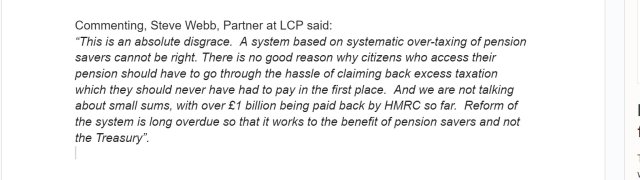
The £48m repaid by HMRC to taxpayers  is more than double the £22mn in overpaid tax repaid in Q1 last year. In one way, we should be celebrating that people are engaging with their pensions by spending their pension pot. This money is – according to Jon Greer of Quilter, demonstrating “the continued necessity for people to access their pension funds amidst the cost-of-living crisis”. If pension saving is helping people heat and eat , then good. We save to spend and that formula works for the Treasury as it does for the person feeding the meter.

In another way, we could be roundly condemning a system, which eight years after kicking off is still working very badly.

I’m with Steve Webb on this, I may be with John Greer if he is right that this increase in money is emergency funding for households in trouble. If however, the Quilter view is that this is money that is no longer attracting management charges- I take a different view.


The need for a wage for life – taxed as a wage for life

When people join a pension scheme, they probably have a vague understanding that the pension scheme will pay them an income when they stop working. That’s what I thought and still do.

The trouble is that for most savers, a pension is a pot of money, which they access at their peril, often with dire tax consequences,

The First Actuarial Muppetometre was designed to help people understand that simply cashing in pensions without taking the care, LITR advises, could leave you..

 Were the HMRC regulated by the FCA and subject to the Consumer Duty , they would be in the dock for abusing their vulnerable customers. (Steve Webb’s point).


The freedom to fuck up is not freedom – it is servitude for all but the few

There has to be another way for people who don’t get pension taxation and don’t get LITR’s , MaPS’ or a financial adviser’s help.

Last week , Pension PlayPen heard from Arun Muralidhar  about a SeLFIE, a sort of national savings bond people could buy which paid back a set rate of income for 20 years.

On Friday, I heard Adrian Boulding , brilliantly explain how a CDC device could turn a pot to a non guaranteed pension (and could be live by the end of this parliament).

So there are other ways available.

It is now up to people like me, and Adrian and Arun and Steve Webb, to make sure that whatever solution we want to simplify the current mess – becomes a reality. I know that Steve’s eventual annuity is a good idea – it’s based on buying an annuity when an annuity makes you feel good (when you are older), I know that Arun’s plan makes sense for people who don’t want to go anywhere anything called “investment” and I know that CDC style pensions are the way forward for the majority of people who want an income but no guarantees. Currently none of these plans are available.

All of these plans give us freedom from freedom, by converting pot into pension. There will be nay-sayers on all sides arguing that people don’t want to lock their money away or rely on others to manage their cashflows. For these people there are financial advisers and DIY spreadsheets to do the cashflow modelling and longevity estimation.

But for most people, financial advice and DIY spreadsheets are no good. They are not a sustainable feature of their retirement living. They want something good that gives them a wage for life – an AgeWage.

We cannot give up on the good, just because the bad is not being complained about. The bad that is being done by HMRC is increasing because we aren’t suggesting good. That is bad on our part, we can’t blame HMRC for everything!

So let’s get on and get these new ideas moving.

Posted in pensions | Tagged , , , , , , | Leave a comment

Jo Cumbo gets real on “real assets” – VFM from the saver’s POV.

Jo Cumbo talks with Darren and Nico on this week’s VFM podcast

Jo is a “once in a generation” pension journalist, we are lucky to have her reporting in this country, I’m lucky to live round the corner from her office so we have the odd coffee together. It’s a privilege and so it is to listen to her for much of the 61 minutes of the podcast.

I’ll leave the personal narrative to her and I’ve written about her contribution to the BSPS debate, as Al Rush said yesterday, without her intervention, much of what happened after would not have happened. That’s the power of the press and the FT in particular.


This podcast is about the deal that workers are getting out of workplace pensions. It is not about the pensions industry though it focusses hard on the Australian’s experience of VFM measurement , concluding that – for all the politics – that is what the DWP are trying to replicate.

Jo – as Laura Trott did in a recent interview with Mona Dohle, focuses on what happens when you start comparing what has actually happened to saver’s money. In Australia, 13 funds got called out for non-performance and 12 had to shut up shop and combine with better managed schemes.

There are mastertrusts , we know , which are failing their members right now. There are DC occupational schemes that aren’t giving value to members – or to sponsors, there are some rubbish non-workplace pensions too (but we’ll get to them other ways).

Jo is in no mood for joshing, this is serious stuff. If we want a successful workplace pension system we are going to need to get people talking about their pensions like Aussies do about their Supers, we are going to have a proper means for employers , trustees and (eventually) members, to compare their pots and we are going to have to start getting real about real assets.

The conversation about investments in productive (formerly patient) capital , between Nico and Jo forms the heart of this episode and it is very good. Darren is also good , putting the argument into the political and regulatory context.

But it’s Jo’s focus on what members get out of paying more on trust that an illiquid asset will deliver a better retirement standing of living – that makes this section hum.

The debate is about who gets the value. Is it politicians who can boast how they harnessed Auto-Enrolment to build Britain back better? Is it the Treasury who can ease up on debt issuance and rely, as Australian States do, on pensions schemes to fund their bridges and hospitals? Or is it those marshalling the money into private markets for a living?

Understandably, Jo is suspicious of the motivation of all these stakeholders and returns again and again to the fiduciary duty of Australian trustees to act to the financial advantage of members. Bottom line, Australian Supers are not a free for all, due diligence is done and organizations such as Gregg McClymont’s  IFM invest in a responsible way, because of a well structured and governed access to private markets.

I sense that Jo does not believe that either Government or their regulators have yet to replicate this access in the UK. Jo’s beef with VFM is that it assumes there is alignment between Government and Industry on the benefits of consolidation without much evidence to back it up. Nico comes in here,  fresh from trying to set up such access, with some strong words about why Jo is right to be sceptical.

But I am trying to replicate a conversation that you can listen to yourselves. I get the feeling that Jo will support simple VFM tests that put performance first but quality of service in the mix. I am quite sure she will want to see cost and charges in the mix but not as the arbiter of good but as a means to see what we are paying for compared with what we are buying.

Personally, I think the DWP have got it right when calling for a split between investment and “other” costs within the AMC. Ultimately , the measure of how efficient the management of an asset is , lies in the price of the asset not the rents extracted. Warren Buffet & Co may pay themselves a lot to run Berkshire Hathaway but what do shareholders care? What we should be interested in , is the amount of our charges being paid to managers of our money and the amount retained by the provider of other services.  But this is getting too deep into the weeds. Jo is right to point to Chris Sier’s work on the cost and charges templates, we know more about investment efficiency today than we did in the past but there is clearly much more to do.

This was, as expected , an excellent use of an hour of my time (as a listen) and I would recommend you  listen to the whole podcast. Next week is Romi Savova , who I’m pleased to see coming in to talk. Pension Bee are currently referred to by many as the “yellow peril”, but not by me. They have done more than most to shake things up. I hope the boys will pick up on Jo’s comments about transfer times in Australia being down to 3 days and continue this conversation in a British context.

Posted in pensions | Leave a comment