


One of the things ordinary people find hardest to work out is why their share of a defined benefit scheme can go up when stock markets go down. This happened last month where the stock market fell.

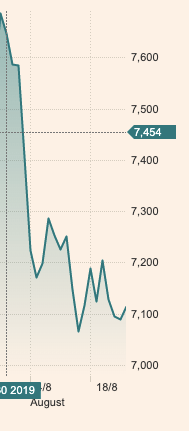
FTSE100 in August 2019
But in August, the 10 year Government Bond yield fell yet again


10 year bond yield (FT)
Most people understand a transfer value to be a “share of the fund” and most people think that pension funds invest in company’s shares. Both thoughts are a little askew.
Firstly , defined benefit pension funds do not pay out a share of the fund, they pay the estimated cost of meeting the promise made to you, based on the actuary’s estimate of the liability (your pension) and of the cost to the fund to pay it.
Most pension funds are now largely invested in “risk-free investments “, by “risk-free” experts mean investments which aren’t impacted by market conditions – in terms of meeting liabilities, pensions funds regard an investment in Government Bonds as risk free.
So a stock market in free-fall no longer impacts pension funds that much. Our transfer values are immune from crashes in equities. Infact transfer values can benefit from market crashes – as money is swiped into gilts, pushing down gilt yields and increasing the price at which gilts need be purchased.
The transfer value represents the amount of cash that would be needed to pay the pension (it’s often called the cash-equivalent transfer value) and when gilt yields fall, the amount of cash needed to pay the pension rises. That’s because the gilts which are yielding less are more expensive to buy.
I know it sounds crazy, but last month your DC pension probably dumped in value but (if you had one) , your DB pension went up (in terms of its transfer value).
Does this make sense?
We are in a world of extremes. Politically we are in the middle of a trade war between the USA and China and a political struggle between Britain and Europe. These big (macro) events are know as “geo-political” tensions and they cause markets to put tin-hats on. Shares are sold off and money invested in risk-free assets, markets seek the strongest currencies (the pound is not one of them) and the fundamental state of economies is ignored for fear of how these economies will change if things go badly wrong.
Does this make sense? Markets are a law unto themselves, they cannot be controlled by central bankers and politicians, though such people’s actions can influence markets in the short term.
In short, you are – in terms of your pensions, in the hands of irrational forces that defy your prediction.
People who were advised last year to transfer may now be wishing they’d hung on a year. Over the past year, the FTSE 100 has fallen 6% , but according to pension consultancy XPS
The continuing fall in gilt yields has pushed transfer values to new record highs, around 10% higher than they were this time last year. Although there is a lot of uncertainty around the future of the financial markets, an increase in transfer values will mean we are likely to see a lot of members investigating their options.
Why do I feel a little queasy?
I feel a little sick of speculation about DB transfer values; I’m not the only one. Recent FCA papers warn that many transfers are wrongly advised, there is insufficient reason for people to be transferring to warrant the loss of guarantees inherent in the pension given up.
And yet there is still a view among those who advise pension fund that the payment of transfer values actually helps a pension scheme. There is something in that final sentence that makes me feel sick
…we are likely to see a lot of members investigating their options.
I am not in any way accusing the statement’s author , XPS’ Mark Barlow of encouraging transfers, but anyone who has read this article will realise that the temptation to go for a transfer today is higher than it’s ever been – transfer values are at record levels.
The reason for these high values is – as Barlow also says, because scheme liabilities are valued using the return expected from the scheme’s fund and that return trends towards the return (or yield) on Government Bonds (gilts).
This is an entirely artificial situation, created by the mania to match liabilities with risk-free assets. It is the by-product of financial economics which uses theory and ignores practice. The theory is that schemes dump risk, the practice is that risk is dumped on members. That is why I feel queasy.
Enhancing Transfer Values with no capacity to transfer
And the worst of it is this. If you do as a DB member with a CETV, investigate the option to transfer, you will find it increasingly hard to get financial advice.
Financial advisers who can give advice on transfers (about one in three regulated) are often subject to quotas imposed by Professional Indemnity Insurers, many firms with capacity to advise have withdrawn from doing so and some firms have been stopped from doing so by the FCA.
The member tempted to investigate options is now facing a frustrating task. Though he and she may see good news in the CETV increase, they may face more obstacles than ever in taking money.
For the first time, I sense that actuaries are waking up to the consequences of the de-risking they have watched happen (and often advised to happen). Mark Barlow’s statement this month ends
“Trustees and sponsors should ensure that members considering long term irreversible decisions are being provided with sufficient education and support to enable them to make the right decision for their circumstances and financial futures. We would also recommend schemes consider how the substantial changes in market conditions have affected the funding strategy and whether, in light of this, the transfer value basis remains appropriate.”
This is a coded way of saying that the consequences of de-risking may not be as great as we thought. That pension schemes have a social purpose and that at the moment, the way they offer transfer values is causing moral hazard – it’s encouraging the very behaviours that the FCA are trying to prevent.
Actuaries only follow rules when they increase transfer values at times like this, but the transfer value basis – fair as it seems to actuaries – may not be fair to members. Dangling carrots and then locking the carrot away, is no way of managing people’s retirement planning.
An awkward state of affairs.
I think the current state of affairs is best described as awkward. There is no easy way to talk to members about what to do. The head says sieze the opportunity – but the heart says stay where you are. The head says use the contingent charge, but the heart says, enjoy your pension. I could easily turn these formulations round, for some the heart yearns for freedom and the head says no.
And for those who took transfers – the £60bn of us, between 2016 and today, those transfer payments may not be looking quite as healthy as we they did earlier this summer.
How resilient do we feel looking at this chart?
I feel queasy, I feel awkward, so I think does Mark Barlow and so do many actuaries who value pension schemes.
The question is just how sick do you have to feel, before you get off the boat.