The dreary work of the white-collars will be done by AI – what’s wrong with that?

I am pleased to hear that the dreary work of white-collar staff is going to be taken from them by software.

If a blog of podcast can be better written or delivered by software already on my computer but upgraded to answer my questions- good!

What I am asking that can be answered could and should be almost everything about money, what that leaves me is the delight of knowing how I can live my life and what I can do with the time that I have been handed back.

And what it will do is to winnow out the value of the financial services we pay for so that we get value for 0ur money. This includes advice.

Thanks to  and  for this.

Shares in the UK’s largest wealth managers tumbled on Wednesday over concerns about potential disruption from a new AI-led investment tool.  St James’s Place, Britain’s biggest wealth group, fell more than 13 per cent after US-based wealth management platform Altruist launched a tool to help financial advisers personalise clients’ investment strategies.


Collegia for growth

And to suppose workplace pensions aren’t to benefit is churlish. I work closely with a workplace pension run by Collegia that has built up 5,000 young businesses that it has built a payroll for and which comply with the workplace pension regulations using software almost totally through artificial intelligence. 50,000 people are building up pots for the future and their companies have outsourced the problem of retirement provision to software.

To suppose that this level of automation cannot become the normal in terms of interfaces between pension schemes and employer and their staff is ludicrous. The future is with firms like Collegia and with other new players who put technology at the beginning, middle and end of processes. I think of Lumera who are taking over work begun by ITM and delivering success in Europe and now the UK.

These are organisations that are not hidebound to the past but open to the kind of future that Mustafa Suleyman plots.

I am one of more than 500,000 people who follow him, because he built DeepMind and now is building Microsoft AI.

To suppose that I would not want to follow the path he is creating is ludicrous and to imagine a pension system by 2030 that is not aspiring to the future that Collegia, Lumera and others are uncovering today, is short-sighted in the least.

I have written recently about the FCA’s wish to help those offering products built to deliver using AI. It is right that regulators review what they are doing to take into account a new world that is not about to arrive but is already here. This includes the Pensions Regulator.

There are of course parts of what we do that cannot yet be outsourced to the software that we already use. But why be the Luddites of the mid 21st century and deny machines the opportunity to take away our dreary work?

Posted in pensions | Tagged , , , | Leave a comment

The right for pensioners to benefit from investment trusts

Ros is not letting up in her determination to let CDC and DC get access to investment trusts without hindrance.

To my mind, the Investment Trust/Company beats the LTAF in every way but the reward LTAF’s give the financial services industry.

If we are serious in financing the private companies in the UK from pensions (DC and CDC especially) then the Government’s foot must be taken from the throat of investment trusts.

Posted in pensions | Tagged , , | Leave a comment

Guiide don’t beef with the FCA – a video record

FCA

Pension PlayPen’s coffee morning on Tuesday 10th February was a discussion of the FCA’s regulation regime for pension transfers. Here is the video of the hour long session.

This is a world away from the discussions on DB and CDC that have recently featured on the Pension PlayPen.

But they are the world that Guiide, here led by Philip Hodges, together with Tom McPhail and others hold close.

This video features Phil, together with Steve Goddard and Steve Webb. There are some great questions from Gareth Morgan (the Ferret) , John Quinlivan and Pi’s Laura Johns.

Beef

Posted in pensions | Tagged , , | 2 Comments

Stability is not Scale; admin from the Trustee’s point of view


This is the second of a series of articles about pension scheme governance from KGC – written by Hayley Mudge. They are proving very helpful to me and my colleagues as we consider the advent of UMES CDC.

Why Stability is not Scale (downloadble here)

Trustee governance in a consolidated administration market

The following insights reflect patterns we see repeatedly in practice and draw on our long-term observation of the UK pensions administration market. This is informed by two decades of independent research, operational engagement, and governance-focused advisory work with trustees and providers. Since 2009, this has included carrying out administration market surveys, providing us with a consistent view of how operating models, capacity and service delivery has evolved.

For trustees, consolidation in the pensions administration market is often experienced indirectly. Changes tend to occur outside the scheme’s immediate control, through provider mergers, ownership change, platform transitions or market exits. Yet their consequences are felt directly in service continuity, data integrity and member outcomes.

Historically, trustee governance of administration has focused on service performance within an established provider relationship. In a more stable market, this was often sufficient. Today, however, structural change in the administration landscape means risk increasingly arises from how administration is owned, organised and resourced, not solely from day-to-day service delivery.

As providers consolidate and operating models evolve, trustees are more exposed to risks sitting upstream of traditional oversight mechanisms: capacity constraints, transition risk, and decisions taken at group level that may reshape delivery without a formal re-tender or decision point. These risks are not visible through standard reporting, but they can have material implications for scheme stability and member experience.

This section considers how trustees should interpret these market dynamics through a governance lens. It explores why scale does not automatically equate to stability, how ownership complexity changes the nature of oversight, and why market exits are increasingly relevant to trustee risk management, even where a scheme’s own administrator appears unchanged.

Article content

Stability is not Scale

One of the most consistent patterns we observe is structural stability is often a better indicator of service continuity than organisational size. The five remaining firms without any structural change are a real mix in terms of size from large Employee Benefit Consultancies (EBC’s) to smaller EBC’s and two stand-alone administrators.

Administrators which have avoided repeated ownership change, platform migration or operating-model redesign typically:

  • experienced fewer disruptive transition events
  • retained scheme-specific knowledge for longer
  • operated within more predictable delivery frameworks

From a governance standpoint, this matters because trustees ultimately manage operational risk, not brand strength. Size may offer financial resilience, but it does not remove the execution risks associated with consolidation.


KGC Insight:

Trustees should treat frequent structural change as an operational risk factor to be actively governed, rather than a neutral commercial event. The market is very acquisitive, and we believe more change is on the horizon. Attrition rates of administrators’ employees should be of interest. We are all aware of the capacity and resourcing issues, further changes in the market will continue to impact these.


Ownership complexity has governance consequences

The market has increasingly moved towards group ownership structures, carve-outs and spin-offs. In many cases, trustees now contract with an administrator whose:

  • strategic priorities are set outside the administration function including decisions around investment, systems, pricing, future acquisitions and/or exit strategy
  • investment horizons driven by group or shareholder objectives
  • operating models are subject to future change beyond trustee control

The organisation delivering day-to-day services to a scheme is often not the organisation making the most important strategic decisions about administration and this separation creates governance risk if it’s not properly understood and managed.


KGC Insight:

While these structures are not inherently negative, they create governance blind spots if not explicitly addressed. Trustees need greater clarity over:

  • where administration sits within their provider’s wider group
  • how future ownership change is managed operationally
  • if they find their provider is part of an acquisition, what protections exist during periods of transition

Even where long term relationships and stable Business As Usual (BAU) service exists, trustees may still be exposed to a re-location of services, disruption through the integration of newly acquired clients and cost driven model changes. They could be exposed to all these risks without a re-tender, formal decision point or influence.

Administration oversight is not about SLAs; it’s about understanding who ultimately controls the operating model and mitigating the associated risks.


Market exits are a feature, not a failure. But they are not consequence free

The withdrawal of well-known firms from pensions administration reflects a structural reality – administration is operationally demanding, margin-sensitive and risk-intensive. We are already experiencing a shortage of experienced administrators and when a provider exits the market, capacity does not always reappear elsewhere. This then has a domino effect on capacity restraints for BAU and all other projects demanding attention, coupled with growing regulatory and data demands.

Exits and acquisitions therefore warrant enhanced trustee scrutiny of continuity, data ownership and transition governance.

From a trustee perspective, exits should not automatically be read as negative. Governance usually takes the form of performance monitoring, breach reporting and SLA compliance but a provider exit shines the light on data ownership, continuity planning and market capacity awareness. All of which are not always consistently applied or stress tested. Most of the time, responses are made quickly and without the benefit of a more structured review.


KGC insight:

To date, much of the market has optimised for commercial efficiency rather than operational resilience. However, regulatory focus is now extending beyond day-to-day administration quality to include financial resilience and continuity of service. The Pensions Regulator (TPR) has also turned its attention firmly towards the administration ecosystem, evidenced by its updated Administration Guidance released in December 2025.

When an administrator exits or reshapes its presence, trustees should focus less on why and more on how the transition is governed, including data integrity, resource continuity and accountability during change. Capacity risk should be considered alongside covenant and funding risk. Trustees should also consider what they would do if their current provider exited the market.


Trustee perspective: bringing governance upstream

Taken together, these observations highlight a shift in where administration risk now sits for trustees. In a consolidated and continuously evolving market, the most material risks increasingly arise outside the day-to-day service relationship, shaped instead by ownership structures, operating model change and market capacity.

Traditional oversight mechanisms remain necessary, but they are no longer sufficient on their own. Performance reporting and SLA monitoring tend to reflect outcomes once change has already occurred, whereas many of the most consequential risks now emerge earlier – when providers consolidate, exit, reconfigure or rebalance investment priorities at group level.

For trustees, this does not imply consolidation is inherently problematic, nor that size or scale should be avoided. It does, however, underline the importance of understanding how an administrator’s stability is created and maintained, how future change is governed, and where trustees sit in relation to decisions which may materially affect delivery.

In this context, effective trustee governance increasingly requires a broader, more upstream lens. One considering structural stability, ownership complexity and market exits as core components of operational risk management, rather than peripheral market activity. The challenge is not to predict change, but to ensure governance frameworks are robust enough to accommodate it.

The next article considers consolidation from the administrators’ perspective, examining how peer behaviour reflects operating reality across the market.
Posted in pensions | Tagged , , , , , | Leave a comment

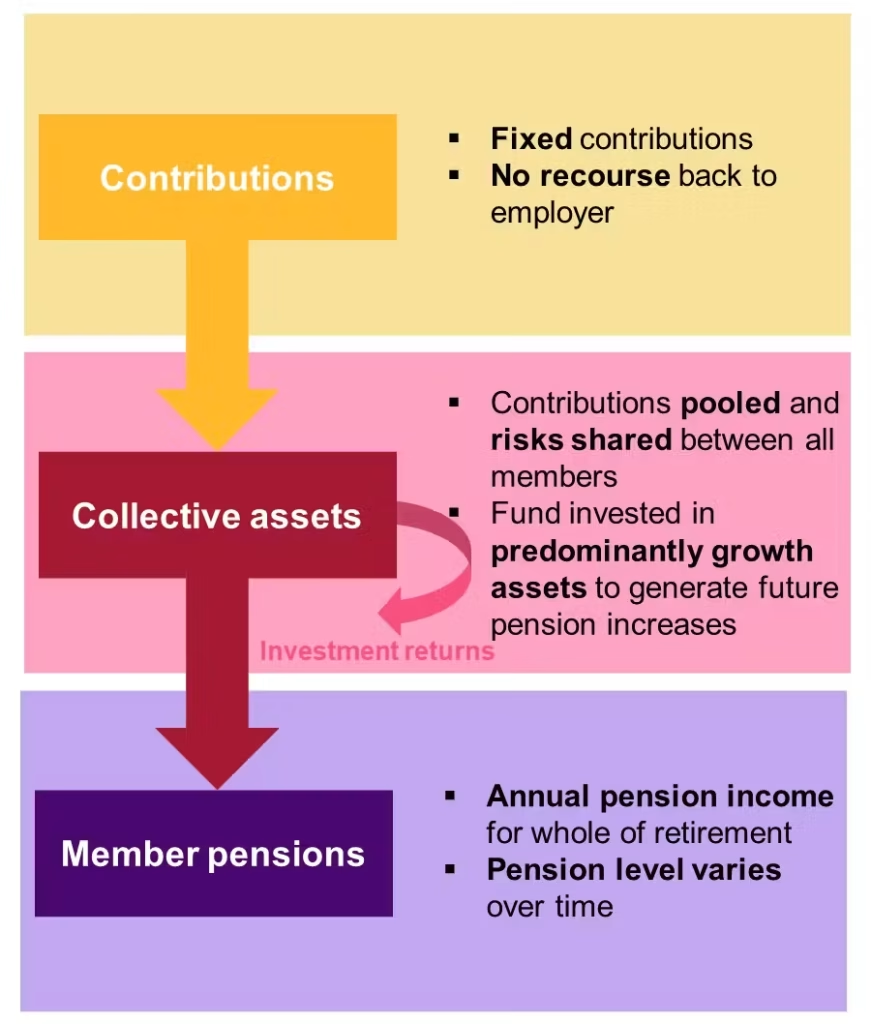
What happens if a CDC pension goes wrong?

This is the way that CDC works and we’d hope that a CDC sees an infinite horizon for its future but……

If a DB gets into trouble it goes to its sponsor for more money and if in extremis the sponsor cannot meet the bill then the scheme goes into the PPF. But it’s not like that if a CDC cannot pay pensions with a target CDC of inflation (CPI) on increases.

If it just takes too much out to meet its costs and doesn’t make enough on its investments, then it can trigger action from the Pension Regulator. TPR can demand action to put things right, pass the CDC to another CDC provider or close down in an orderly fashion. Using the word “continuity” may sound odd but it’s what the DWP dreamed up and what the Pension Regulator outlines on its website, as the fate for failing CDC schemes.

If TPR considers things are going wrong it triggers an event that leads to things being put right so that members do not suffer. There is no PPF, no sponsor to fall back on, continuity is worked out by the CDC scheme , perhaps with the help of another CDC scheme. Just as with the workplace master trusts, there is value to one CDC scheme of being one of a number of CDC schemes.


Continuity strategies for CDC

A CDC scheme does not set out to fail but it does need a continuity strategy that includes  preparing for a triggering event and the three continuity options if a triggering event occurs.

Since August 2022, the Pensions Regulator has had a continuity strategy: overview, written down. This is an overview of the requirement to have a continuity strategy that sets out how members interests will be protected after a triggering event.

This includes an understanding of the CDC’s preparing for a triggering event. This is an ongoing requirement of the trustees and the proprietor assessing the risk of a triggering event, planning the initial response and continuing to operate the scheme, even when things aren’t going so well


When a trigger event occurs and the scheme needs to follow a continuity strategy

The most final strategy that could be followed is called Continuity option 1:  this means discharging  liabilities and winding up  The Pension Regulator lays out the key issues to consider when discharging the scheme’s liabilities and winding it up. All members continue to get a pension or a promise of a pension but with another scheme.

The happiest strategy that could be followed is called Continuity option 2: this means resolving what brought about the triggering event  Once again TPR outlines the key issues to consider when resolving a triggering event. To use the colloquial , this is about putting things right.

The third option, where neither option 1 or 2 can be followed is called Continuity option 3: this means closing the scheme to new contributions or members Once again TPR lays out the key issues to consider when closing the scheme to new contributions or members. This is not so immediately final and may be thought of as  the “option of last resort”. For that reason, it needs to be taken on board by CDC schemes as what they must consider possible if all else fails. For those who like to know what the worst looks like, the Pensions Regulator lays things out.

In my view , Continuity 3 should be learned and lodged  in a CDC proprietor’s  memory. It is not something that a proprietor or trustees should want to happen but it is something they take on as their duty in the event of all else failing.


Posted in pensions | Tagged , , , | 1 Comment

PASA’s thoughts on how TPR’s code of practice works for CDC

View company: PASA - Pensions Administration Standards Association CIC

PASA – Pensions Administration Standards Association CIC

PASA has submitted its response to The Pensions Regulator’s consultation on Extending the Collective Defined Contribution (CDC) Code of Practice.

Our response focuses on the practical administration and operational considerations needed to support effective delivery of CDC schemes, including:
🔹 the value of a single CDC Code (and longer-term alignment with the General Code)
🔹 the need for greater clarity on future changes and timeframes
🔹 avoiding duplication through clearer cross-referencing to legislation and guidance
🔹 the importance of strong administration standards to support member confidence

A huge thank you to the members of the PASA CDC Focus Group and the Industry Policy Committee for their expertise and contribution in shaping this response.

The full response is available here: https://lnkd.in/eXuZyHBZ

Posted in pensions | Tagged , | Leave a comment

Change of tack at BP – time for BP pensioners to know!

FT author
Assistant News Editor and City Bulletin Writer
February 10 2026
Posted in pensions | Tagged , | 1 Comment

Rulers, Rules & Ruining Retirement – today’s Guiided Coffee morning

Philip Hodges


Pension Playpen Logo


Posted in pensions | Tagged , | Leave a comment

Burns and Timpson are great men for today!

Thanks to my digital contact Johnny Timpson for this poem he posted a couple of weeks ago on Burns Night. I had never properly read it before but in the context of my friendship with Johnny and the photos he includes at the bottom of his post, it has an immediacy that reaches out over a couple of hundred years.

I’m sorry I did not catch this first time around but it’s point is not lost. Burns set his feelings to words and those words can wait the couple of weeks since posting!

I will post two Scottish heroes


Something amiss?

To end – this fine suggestion from Derek Scott

There seems to be something amiss with your Johnny Timpson item this morning, or it may just be me …

Having introduced you to Emmylou, the modern day best interpreter of Burns in song is Eddi:

Posted in pensions | Tagged , , , | 1 Comment

What will AI do to blogging? Or should the question be the other way round?

Last week my blogs saw more reads of my posts than any week since 2009 when this blog started. I cannot say why but I can say that there was a lot of reading from the USA which looks like it wasn’t done by humans but by computers. The numbers of subscribers to this blog remains constant and I have no explanation for this explosion.

I have while blogging my thinking before work even starts , been finding that my work is a lot easier than it used to be.  It is because so much of what I do- create ideas and commit them to words is taken up by software that transforms what I wanted to say to how I want to say it.

My favorite organ, the FT, stands up for artificial intelligence makes the point. Can you or I be sure that this beautifully written paragraph is straight from the fingers of  Nathan Graf? 

I don’t know and I don’t care – it touches me in a good place.

I don’t know Nathan, for all I know he could be artificial though I have contacted him to say I appreciated his message

The emotional truth behind what I do for my companies is my unique contribution. I write what I feel not what I think is compliant to law and regulation and it certainly doesn’t set out to win popularity contests.

But what I say can become more compliant, more easy for my readers to digest and more valuable to the organisations I own and those we work for, by being processed by AI.

As for blogging, this is where all the ideas that we use in business start and because what I think is authentically me, I find my blogs valuable to me. It is comforting when they are well read and I like the comments from the tight numbers of readers who engage in conversations on my blog and on social media.

And this interaction with those who read me , has I think some value to me, my businesses and to those of others. As Nathan Graf sums up, so I feel this morning , Nathan argues that the buffeting the AI stocks got last week especially and this year generally will make AI reset and ultimately stronger

Organisations who martial data and sell it into the market have been particularly hit,

Some of these organisations will not survive, they will not prove valuable to those who use them and they will either close or be integrated into others.

We will work out what information we get from the market is valuable as “true” to the feelings of users because we all ultimately are users and test ideas using our own emotional reactions. We know when AI is doing its job because we test insights from AI against our experience. Here’s Nathan

AI will deepen these moats by surfacing new insights from the data and automating portions of the workflow, accelerating business productivity. And the sector will reap its fair share of the gains.

I asked myself what AI will do to blogging and I am beginning to think that I should be asking what blogging can do to AI. Did all those thousands of reads that I got last week occur from humans or from robots? It doesn’t really matter to me the blogger. I am hear to set down what I see as true and I will fault or be found valuable because of my capacity to articulate my thinking and my feeling.

Thanks very much for bearing with me, it is very wet and windy outside and I am by the sea in the dark. I could not be more in touch with what I do , nor grateful for the AI that helps me blog and keeps me blogging. As far as I know, AI does not feel the cold and wind and rain of Poole, nor is it inspired by the dark of the early morning before the sky lightens.

So I have a unique gift to give AI in return for its gift to me! My blogging is feeding AI and so is your reading and commenting!


Posted in pensions | Tagged , , | Leave a comment