

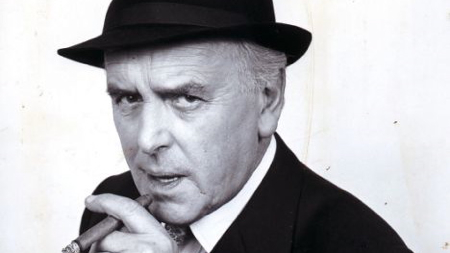
Daley looked back to the days when one’s word was one’s bond and the future of CDIs and credit derivatives. If there was one figure fit to usher in this brave new world, it was Arthur Daley.
Today I hear that one of the last of the mutuals will be raising capital from the stock market in what is being called a “bale-in”. The Co-Op is hardly too big to fail and I fear it is too small to bale, it is easy meat for Megabank who must eye its relationships with its customers with some envy. Trust is hard won and easily lost.
Today is also a day when I am thinking forward (rather than nostalgically) at the value of mutuality in its purest form. There are still mutual models in pensions – BlueSky pensions actually sets its charges each year on the collective experience the year before, the States of Jersey Pension Scheme relies on a mutual agreement between the taxpayer and the beneficiaries of the scheme (there is a 70% overlap!). Some mutual insurers remain (Royal London and a handful of friendly societies).
However, the vast majority of pension benefits are now guaranteed and those guarantees revert either to banks or insurers. The insurers are typically reinsured and much of the risk reverts to the capital markets.Indeed the old concept of social insurance in which a risk is pooled with other risks and secured by mutual interest in the survival of the pool is almost dead.
Almost but not quite.
I am saddened when I read statements such as this
I think it unlikely that the pendulum will swing, in my lifetime, back to the point where employers bear the risks of longevity and investment investment performance. I would like to see some form of DA, but at the moment I think it more likely that this might come from employees taking some kind of insurance or paying a levy to ensure that the value of their pot is not eventually worth less than the payments in. Or possibly that a limited level of positive return be guaranteed.
My sadness is for the “definition of ambition” or more precisely for the paucity of ambition. We have become so obsessed with the paradigm created by Megabank that we consider a “limited level of positive return..guaranteed” something to aspire to.
Were we defined benefit schemes, our balance sheets would show a massive deficit between expectation and anticipated delivery. This deficit can only be filled by huge contributions and favourable markets (in which the fund must participate).
The idea that a DB scheme could , when so in deficit, exchange a growth strategy for a “limited level of positive return-guaranteed” is laughable. All that would do would be to crystallise the deficit and guarantee non-payment of some of the promised pension.
The only way (bar a cash-call on the employer) that a DB plan can return to solvency is through prudent management of the liabilities and some ambition to make the assets grow.
Our current obsession with guaranteeing pensions with annuities purchased at the current distorted rates is just another example of our craven capitulation to the capital markets. These guarantees we purchase are no longer insured by other retirees of the insurer who pool risk, they are simply backed by fixed income securities with tail risk reinsured by European or American insurance companies who themselves pass on much of the risk to the likes of Credit Suisse and Deutsche Bank who securitise it. Megabank always gets its cut.
We need to look back, not nostalgically, but with an eye to what worked. As John Kaye is keen to point out, defaulting on a building society loan was an event, credit was not available to the uncreditworthy and worthiness had to be earned. The system of credit scoring employed by the banks last decade led to the carnage of 2008 when it turned out that machines could not predict human behavior and human behaviour detoriated when it was accountable only to an automated credit rating.
The mutual model, unlike Arthur Daly’s Eurobond, does not rely on a specious banking concept but on genuine bonds that tie people, families, communities , industries and ultimately our national fabric together.
We need not look back, we can look sideways to our European cousins in Holland, Sweden, Denmark and Norway, all of whom use mutual models as a means of delivering social security.
Sooner or later the coin will drop. It’s beginning to drop already, look at the Nationwide Building Society adverts. The idea of breaking RBS up into regional units that put people and communities back into the lending picture is another example of mutuality reasserting itself.
Pension people need not be in thrall to the banks. Swaps are not free to pension funds (as asserted last week by SEI at #PP13 but pension funds can be free of banks if they fight hard and long enough.
The moment that we throw off the shackles of guarantees and re-embrace the principles of social insurance , mutual credit and inter-generational transfers, the sooner we will have Steve Webb’s vision for Defined Ambition.
We always moan that there is no single definition of Defined Ambition – try this
Pensions without banks
Related articles
- Opt in to certainty (henrytapper.com)
- What a charge cap would mean for insurers (henrytapper.com)
- A time for action not tears! (henrytapper.com)
- Doomed Europe (blogs.reuters.com)
- Ghana eyes $1bn Eurobond (blogs.ft.com)
- George Soros Says Euro To Eventually Destroy European Union – OpEd (albanytribune.com)