
The word “saving” implies “deferred gratification”. For most people , pension saving starts with work and the payment of national insurance. My national insurance record started when I was 16 and continues to today. By the time I reach state pension age I will have paid national insurance for over 50 years , 15 more than are needed to get a full state pension.
I can see why many people consider having to wait to get their state pension till state pension age is a “bad thing”. Aegon are suggesting to Government that offering people the opportunity to take a lower state pension, one , two or even three years early would be a “good thing”. It is a populist idea that is (as Aegon say) aligned to the increasingly flexible rules on the taking of private pensions.
Having worked in insurance companies, I know that the prevailing thinking is that the state pension is something that is paid on top of your private pension. Part of this is personal, historically insurance companies sponsored DB pensions which have often paid out more than the state pension. Even the DC rates of contribution available to those in the financial services industry are well ahead of AE minima and of course financial services wages exceed those of other sectors of the economy (on average).
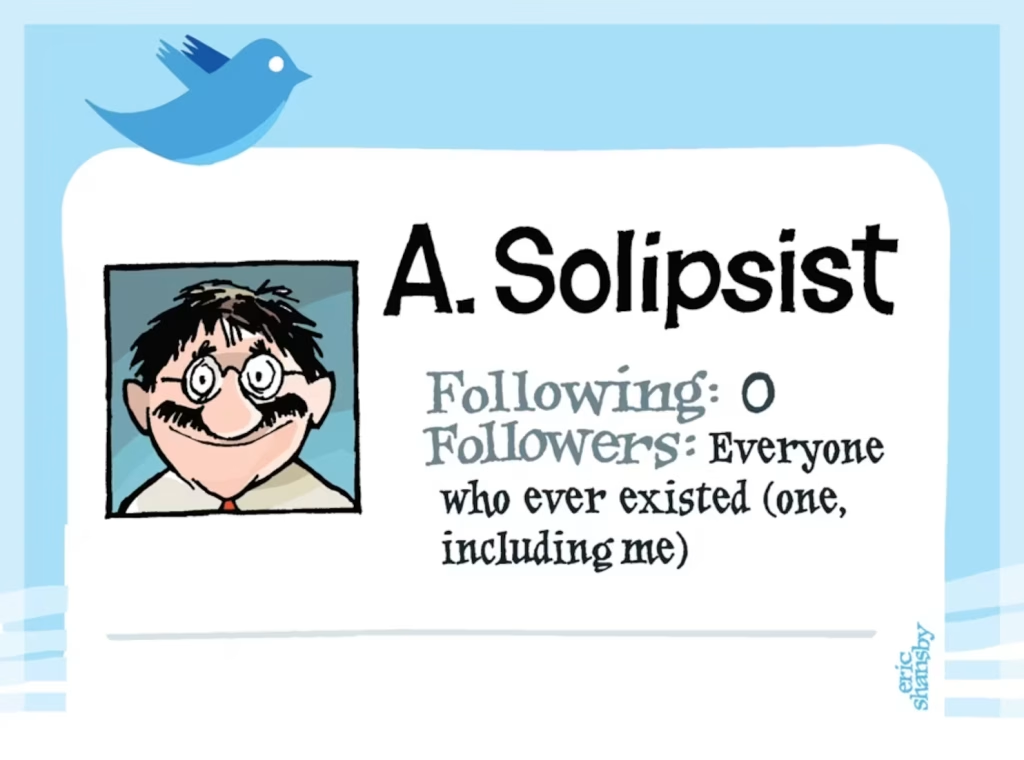
A degree of solipsism is inevitable.
The Government argues that people in their sixties should stay at work – partly on productivity grounds and partly because they don’t have the money to pay pensions for longer. We know that increasing numbers of older people have disappeared from the workforce and it is thought that many have grown tired and sick and have voluntarily withdrawn their labour and are not claiming benefits. These are presumably the kind of people who could take the state pension early and enjoy less for longer. I expect the Treasury would see this as an incentive for the over sixties to be less rather than more productive.
But though I have sympathy for the Government, I can see Aegon’s point. The IFS point out that the highest incidence of later life poverty is amongst those within five years of retirement and there seems to be a lag between people’s expectations and the realities of the state pension age. This is not just a WASPI problem, my bank will not lend me money on my mortgage past 65 , even though I borrowed when my state pension age had gone up to 67. Many occupational pension schemes do not align normal retirement age with state pension age, some employments still have a retirement age where people end their contract of employment prior to the state pension age,
This is perhaps the heart of the problem. People are (as Phoenix Insight comment in this Corporate Adviser article) confused about the state pension age. Phoenix claim that many who they speak to now think that they will get a pension paid from a pot of money built up for them from national insurance. This suggests that private pensions really are wagging the state pension dog!
This ongoing confusion between the payment of pensions and the provision of a pot works both ways, Ray Chinn – when he was in charge of the member experience at Nest, explained that more than a third of the people in Nest thought they were contributing to the state pension. Since Nest purported to be a pension and was owned by the Government, they could be forgiven.
In my experience, people do not understand the difference from an unfunded or funded pension and find it hard to work out why a pension pot is not a pension. The real confusion is that we are confusing pension outcomes with ISA outcomes and promoting the concept of “wealth” over “insurance”. A pension is an insurance against living too long while wealth’s principle risk is that it cannot be preserved.
While I have some sympathy with Aegon’s position, I think they have private savings wagging the pension dog .
The solution isn’t earlier gratification from the state pension, but better management of private savings. Today “pensions” can be drawn from age 55 and spent by age 56, that’s not deferred gratification but a recipe for confusion.


NI is a tax
OAP is a benefit IF you collect the tokens.
Money Box says a full post 2016 OAP is worth £250,000 for 30% of average wage.
The equation is not difficult and the question to answer is
” at what level do you plan to be broke”
adjust the £250,000 for inflation or better still a living wage
It may suprise but you can use more than 100% of final salary in retirement there is so much more to do!!
How are your savings/retirement plans going?