


The FCA has now written to a total of 3,591 defined benefit (DB) pension transfer advice customers this year to tell them they may be entitled to compensation.
And it has contacted nearly 7,700 former members of the British Steel Pension Scheme explaining that they might have a claim.
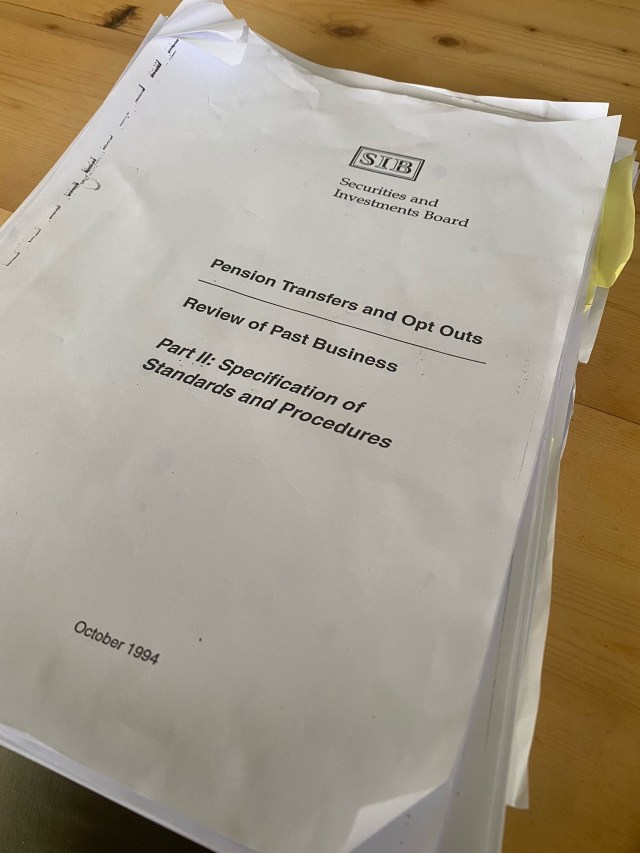
These are seriously big numbers of claimants, so it’s worth considering just what their claim might be. Let’s look again at the rules established by the Securities and Investment Board 27 years ago (and still used by the Financial Services Compensation Scheme today)


extracts of the SIB rulebook supplied by Al Rush (with thanks)
Section 601(e) is how compensation is being calculated today, 602 is how the SIB wanted things done. Section 604 makes it clear that “reinstatement is normally an appropriate form of redress“.
But in practice, reinstatement is rarely an option as the FSCS compensation is limited (£160k falling to £85k where there is no adviser in place) and the ceding scheme is under no obligation to have transferred rights back at any price.
So in practice, compensation is being paid into the personal pensions (now grandly called SIPPs) as “augmentation”. The compensation is calculated by FSCS by assessing the additional costs and charges that need to be met by the SIPP holder to manage the pot and convert it to a pension. These expenses can be heavy and compensation is becoming a matter of contention. Advisers can reduce their charges to reduce their compensation, but we all know that where there is no ongoing fee, there is unlikely to be a sustainable service.
The payment of “cash in hand” compensation (which is now become a regular financial windfall for some claimants) will further dilute the sustainability of these SIPPs to mirror the benefits of the ceding DB scheme.
The one alternative remedy that has not been spoken of (yet) is the guarantee to mirror occupational scheme benefits. Here restitution is of the original purpose of the pension scheme, not to the original scheme itself.
No compensation without restitution


Simply piling money into a SIPP , where the SIPP was considered unsuitable in the first place, is a poor way to compensate someone for the loss of a pension , the SIPP is not a pension but a pot of money from which an income can be drawn, it offers no longevity protection and no certainty that money invested will be sufficient to match the pension given up. For many people, the risks of money running out create commensurate risks of an overly conservative spending plan which leaves households short of cash in the short term as the pot is hoarded, it can also lead to the adoption of overly conservative investment strategies targeting wealth preservation rather than the payment of a replacement income.
For all these reasons, we should be campaigning for “no compensation without restitution” but restitution into what?
Restitution into the BSPS or PPF?
Under the RAA entered into by Tata , BSPS members could have taken no choice and now have rights under the PPF, but the right to transfer DB benefits ceased at the end of the Time to Choose. Most people do not get the option to default into the PPF and the PPF shows no sign of offering restitution to those who have lost their pensions. I very much doubt it feels it can be used for these purposes and in any event, those paying levies would object.
The PPF has commented on the blog since publication explaining the situation in a tweet
You’re right that former BSPS members can’t re-join their old scheme – it’s not permitted by law. The Pensions Act 2004 doesn’t allow members to be readmitted to a DB scheme once it has entered a PPF assessment period, and so this equally applies to BSPS.
— Pension Protection Fund (@PPF) October 19, 2021
Restitution into commercial DB plans?
There is a new breed of commercial DB plan known as a super trust, capable of offering membership to former member of DB plans with the means of buying back into the pension scheme.
In these plans, the risks of meeting the pensions are carried not by other employers (as with DB master trusts) but by the shareholders of the super trusts or insurance companies. If there is consent to carry the risk, then there is no imposition of risk – as might be the case where there is an ongoing levy (PPF) or recourse to the original sponsors (master trusts)
The FCA and FSCS should look to these plans and look to the established insurers in the buy-out market to see if offers of restitution can be made using their collective clout.
I am not sure that these options have been properly explored and now is the time to explore them.
The money from FSCS must be spent wisely
Many claims against advisers via the Financial Ombudsman Scheme end up being claims against FSCS and ultimately against the levy. Good advisers who are paying into the levy do not look kindly on payments being made into SIPPs which are seen to be part of the problem.
If claims are successful it is because the Financial Ombudsman reckons that the advice to transfer was flawed and/or the destination of the transfer was unsuitable. Either way, ploughing more money into a SIPP or as cash in hand is not aligning the compensation with the best interests of the victim.
The sooner we can find a way to return people to their pensions – the better. Let’s hope that innovation can play a part in this. We should be open to change, much has changed in 27 years but the fundamental need for a wage for life after a lifetime of earning – hasn’t.


Debate on twitter
Since I published this , there has been a lively debate on twitter focusing on the impact of moving to restitution on DB claims. Would claims fall off , if the claim to succeed required the giving up of the SIPP in exchange for a mirror benefit?
The review I worked on treated reinstatement as a top up to their personal pension in most cases, so it’s a no lose gamble in terms of complaining. If you were even slightly morally questionable, why wouldn’t just you complain? Nothing to lose!
— Simon Weeks (@Siweeks) October 19, 2021
Hard to win a complaint and then argue you don’t want the benefit you complained about losing?
— David Penney (@DavidPenneyPRW) October 19, 2021