

Lucy Kellaway has written a good article in the FT about ageism. Frances Coppola seems to have had a light bulb moment when reading it.
Great, great article. We all need to re-examine our attitudes towards older people. That includes older people themselves – or rather ourselves, since I am the same age as Lucy. https://t.co/6OHkIM3UGi
— Furious Cassandra (@Frances_Coppola) January 15, 2022
So did I.
The article starts with the story of Ian Tapping, a project manager at the Ministry of Defence, called a meeting with HR. He had been in dispute with his employer and wanted to make a bullying and harassment claim. In the course of the conversation his HR manager asked when he intended to retire — Tapping, who was in his early sixties, subsequently quit and sued the MoD for age discrimination.
Kellaway remarks drily “last month he won his case”.
Demography is our destiny
If you recognise that phrase, you’ve probably been listening to Amol Rajan’s excellent podcasts on rethinking population
The podcasts are based on an amazing insight = that to have a positive destiny a country must either procreate faster, open its borders to other ethnicities or make an ageing workforce more productive; infact he argues you have to do two out of three . Even if demographic isn’t the only pointer to our destiny as a nation, it is a powerful pointer to why things have happened in our past. Think Japan, Nigeria, Indonesia, continental Europe, then think UK.
Asking people when they are expecting to retire, isn’t encouraging people to work longer but until recently people had to leave jobs because they had reached normal retirement age. Retirement wasn’t a choice, but an obligation (with a pension as compensation).
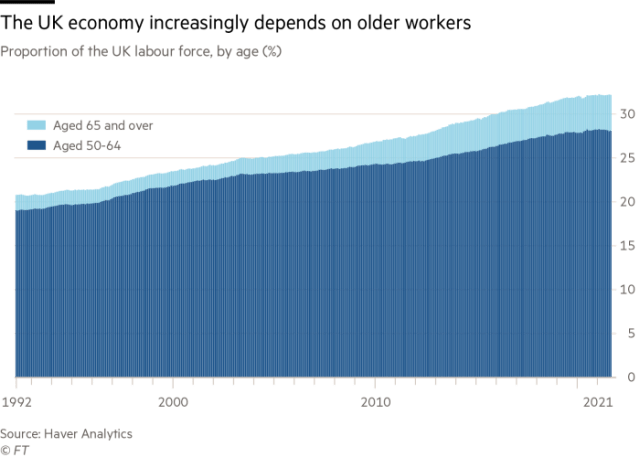
Lucy Kellaway rightly points out that Britain is doing a good job of keeping older workers productive. It’s a lot easier working longer than it was even 20 years ago. And we are taking steps to get people to think of pensions as a moveable feast which are paid when we need them rather than when we want them (well at least that’s how the State Pension looks to work).

The idea that older workers should move out of the way for younger and thrusting colleagues is still prevalent, but as I have found at AgeWage, the choice of moving into a “senior” position in an organisation, is quite an easy one to make. I enjoy having the chance to use my experience and not compete with more energetic colleagues for work I am no longer best placed to do.
If this represents a happy scene of intergenerational harmony , then good. We want happiness in our workforces. We do not have the problems of other countries with gerontocracy, where companies are dominated by the old that they stagnate. Diversification includes age and apart from a few professions (pension trustees being one), I had thought , till I read Lucy’s article that Britain is remarkably un-ageist.
But this is what Lucy is saying
Not only is age the poor relation in diversity policies, it is still perfectly acceptable in polite society to be rampantly ageist.
And she argues that we are as a society institutionally ageist.
These assumptions about older workers — that we lack energy, can’t do tech, can’t generate new ideas — are not only widespread but are acquired so young they seem to be almost innate.
A side of me wants to be outraged with Frances and Lucy and a part of me wants to put my feet up and conform to the lazy, tech-stupid fogeyism that I’m supposed to enjoy.
Maybe I will go gently into that deep night but I suspect that my next 30+ years (let’s hope), will be spent wondering whether I’m acting my age or becoming a victim of age (and maybe ageism).
Some days I can relate to Lucy’s self characterisation in a peice she wrote on her 60th bithday
Though I don’t object to being classed as Young-Old, the phrase does not quite capture how I feel right now. A better description would be Aged Adolescent
I do not have Lucy or Jo’s or Frances’ boundless self-confidence, but I do feel more certain with age that I have a place in society and that I am one of the lucky few.
But there are 2m older people in the UK , in age poverty and for them there are diminishing opportunities. For them it is both passion but compassion is needed.
Rather than pulling up the drawbridge and enjoying the fruits of a lucky working life, I would like to labour for a reduction in age poverty through the creation of better means of targeting those who need financial support- with financial support.
Having worked for forty years in pensions, I am at last finding the purpose of that work, which is one of the benefits of getting older. That’s my anti-ageist cream that’s keeping me going!


Lucy Kellaway