

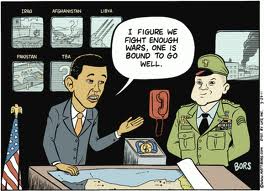
There will be three immediate consequences.
1. We will not open yet another front on the war against terror by declaring war on the Syrian regime of President Assad
2. David Cameron and William Hague’s reputation as international statesmen will be diminished
3. Ed Milliband will emerge, for the first time as a credible leader.
The party political consequences will be put to one side; it will not be till 2015 that we will be able to assess whether this debacle has seriously impaired the Conservative’s chance of re-election. However, the confidence that this will give the Opposition in the short-term should make for an interesting 18 months for all three major parties and for those who enjoy proper political debate. Perhaps for the first time since New Labour, we have a credible Labour party and a credible Labour leader.
The credibility of the Cameron/Hague case was based on open-sourced evidence, primarily the kind of photo and video journalism that we are now used to. We can now source so much of this through social media streams that we seem to be looking at it maturely. Shocking as the photos and videos are, we seem to be viewing them in a wider context that accepts these are only fragments of a wider pattern of suffering.
In a brilliant vox-pop from Damascus on Radio 5 yesterday, I heard an eloquent Syrian reminding us that to be killed by a bullet or asphyxiated by a chemical agent is not much different if you are the victim. The emotional impact is on the viewer. He went on to point out that the horror of chemical weapons is that they are an immediate threat to anyone whereas the mass-slaughter that has been going on for two years in Syria, is a local problem.
For many, myelf included, it seemed that we were being asked to go to war for the selfish reason that we could not tolerate the threat of a chemical attack full stop. The Syrians seem united only in viewing Western interventionism as self-serving. It seems that the majority of MPs agreed. We may feel morally outraged by one atrocity after another but we are learning that we cannot console our consciounces by santioning violence against violence.
Which really gets me to why I am proud of the decision we took last night. For once we have not been bounced into a decision based on the terror or the imagination. Those who have used arguments that by not using weapons, we are legitimising brutality have been voted down. The red line that conveniently gets crossed to justify interventions has been questioned and ultimately found bogus.
What we will find, in our relationship with America, is not the weakness of not following but the strength of our moral conviction. I will be surprised if Obama acts unilaterally because I sense that America will listen to the House of Commons as we have.
Ultimately, Britain has shown itself to be a strong and thoughtful partner to America and has, in a dignified way, concluded that it is not right to intervene militarily. Let us hope that we will be able to use our influence beyond stopping American folly and get the likes of Saudi-Arabia and other local powers to get Assad to see sense.
The destruction he is wreaking on his people and on his nation’s infrastructure already mark him as unfit to rule. If the Middle East is ever going to sort out its problems, it needs to sort out the behaviour of Assad and similar tyrants before the havoc has begun.
I believe that the West has help it can give the fledgling democracies of Egypt, Iraq and Libya and that we can help a lasting peace in Israel and Palestine through our steady and determined adherence to a universal moral code that finds expressions in the various human rights conventions enacted by the UN and similar bodies.
We may ever, through the brave vote of parliament, go some way to bringing Russia back into the fold of democratic nations with our common purpose.
It was a good night for British democracy and I do indeed feel proud to be British on this day. It was a day when sense prevailed over terror and reason over the nightmares of imaginary fears.